

Internship was provided to 45 fresh undergraduates to different projects implemented in Rwanda including the following
- Construction of apartment in Kicukiro District
- Construction of Apartment at Kimironko Sector, Gasabo District
- Construction of Kinigi IDP Model Village
- Ngeruka Model for Agriculture in Bugesera District
All projects were successfully implemented and effective reports were drawn from interns. The level of participation of interns was based on gender balance.
Our interns were given opportunity to supervise the work and contribute to the implementation of some service where applicable.
In the course of the ended year 2021, different projects were implemented and some are still in pipeline from design to implementation phases. EWB- Rwanda in collaboration with EGLISE PRESIBITERIENNE au Rwanda tailored professional trainings to different beneficiaries including the following
Training on sewing machines to beneficiaries entitled Single mothers at Nzove Cell and provision of sewing machines.
A number of beneficiaries were trained and provided machines for sewing. Single mothers were registered into the association and were provided sewing machines as a startup asset to sustainably improve their living conditions.
Technical support on Infrastructure of Kigali de la sale school (at Gahanga)-Kigali City
This project is located in Kigali city, Kicukiro district, Gahanga sector. A school consisting of:
- Teachers accommodation
- Nursery school
- Primary school with its administration and multi-purpose hall
EWB-Rwanda has contributed to avail the design and supervision of the project implementation and hence tailored facilities to fresh graduate’s interns.
Our technical team key interventions include:
- Develop strategic relationship and partnership with key stakeholders
- Interact, build and nature effective working relationship
- Serve as a resource people for disseminating knowledge and skills
- Educate on the key advocacy issues
- Facilitate for building capacity of project team and implementing partners
- Baseline survey, project review and evaluation
- Develop report as and when required
- Capture evidence of good practices in regular basis
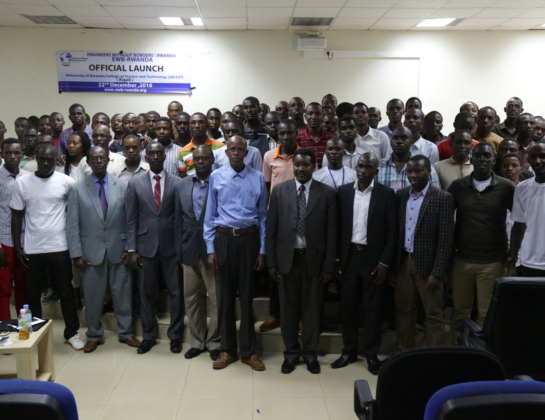
Fresh Graduates are given basic training on the field works before being allowed to practice their knowledge
We believe that education, capacity building, knowledge sharing, appropriate technology and solutions, and long term partnerships are key to ensuring that our impact is sustainable. 45 Fresh graduates from different Universities are given opportunity to exercise their knowledge and follow the ongoing construction projects. We ensure opening the door to our fresh graduates and we connect them to the management of current construction projects as we partner with the owners.
We partner with different private and public institutions to ensure facilitation of our interns is attained efficiently. During the year 2021, a number of 45 fresh graduates were benefiting and passed a period of two (2) months of internship. These students are from different disciplines like Mechanical Engineering (10), Civil Engineering (20), electrical engineering (7), and Agronomy (8). Gender was considered as for 2021, among 45 interns, 25 were females and 20 males.
Population in Bugesera District were given training on the model of agriculture
EPR-Rwanda / Kigali Presbytery in collaboration with EWB-Rwanda initiated the collaboration on the different project by focusing on the project which will help the people to alleviate the poverty. Among of these project are as follows:
- Short course technical training
- Agriculture project
- Water supply and energy
- Others
The cultivable land (EWB-Rwanda hired property) covers 3 hectares. This project was implemented in the Eastern Province, Bugesera District, Ngeruka Sector, Murama Cell and Kinamba Village. 126 local population benefited from working into the field on daily basis on rate of Rwf 1000 to 2000 each per day.
Two main seasons were considered and followed and the production could not be satisfactory as expected due to bad season of the year 2021 (insufficient rainfall) and as pilot program, more studies are expected to ensure the success of the intended program. Main products including maize and beans were piloted where 800 kg of maize and 250 kg of beans were collected. The main cost of the produced in average was 300 frw per kg of each either beans and maize. Nevertheless, the products were provided to be consumed by local population as being the main beneficiaries of the program.
On 10th February, 2022 a team of EWB-Rwanda and the local administration (Murama cell SEDO, Jonas NDARUKIZE) conducted a site visit to undertake an evaluation of the progress of the program and concluded with the following recommendations:
- To ensure the extension of the program is taken place in nearer future
- To undertake a detailed study including soil analysis (geotechnical studies)
- Water shed management and water supply for irrigation
- A detailed business plan and action plan
- To mobilize beneficiaries with permanent technical assistance
- To ensure progressive documentation based on the results and appropriate studies
- To ensure on time planning of cultivable crops and climate change
- To ensure beneficiaries are the core of all activities while to evaluate that their performance base is attained
Beneficiaries were glad for the implementation of the program in their locality and they confirm that the project was a benefit to their improvement in skills and economic growth.
SEDO advises are focusing on the performance of the project and ensuring that the skills attained through the project implementation be tailored to all population improvement of usual agricultural practices.
The Executive Secretary of the EWB-Rwanda recalls that the main objective of the program is to implement the government policy related to intensive agriculture for commercial purpose and ensuring technical support for all beneficiaries.